

IBM Dubuque
IBM Corporation located their new 1300-person Global Technology Service Center in downtown Dubuque, Iowa because of the local region’s commitment to triple bottom line sustainable redevelopment. Working with Dubuque’s public private partnership was consistent with IBM’s corporate values and cutting edge data driven technology aimed at initiating sustainable urban change. The collaboration dramatically improved regional employment opportunities, repaired the historic town fabric, and reduced Dubuque’s environmental footprint while creating over 130,000 SF of LEED Gold office space and IBM’s first new office in the US in a decade.
evolveEA consulted from early design through occupancy, leading IBM and community stakeholder charrettes, educating the design teams about sustainable strategies, developing project goals, adapting green strategies to integrate high tech offices into a historic building, managing the LEED certification efforts, and helping institute green building operation practices post occupancy.
The evolveEA early design charrettes explored project goals and associated green building strategies with IBM and local project stakeholders. At evolveEA’s suggestion, the IBM team elected to pursue LEED for Commercial Interiors certification separate from the Roshek Building Core & Shell LEED certification. This allowed the two projects to focus on sustainable strategies that advanced each clients’ goals while fostering synergies when their efforts overlapped. Adaptive reuse of a historic building minimized the amount new materials required and careful deconstruction provided ample supply of high quality and decorative salvage materials at minimal cost. The location leveraged existing mass transit, parking, city amenities, and cultural opportunities in an exciting walkable urban center. These created a very desirable workplace location for IBM employees and helped to revitalize the downtown. This approach has become a model for the sustainable redevelopment of Dubuque’s adjacent historic millwork district and similar small towns and cities around the country.
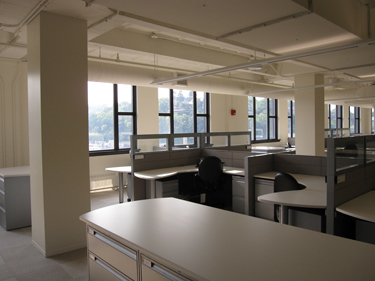
The project provides IBM with completely renovated contemporary high tech commercial offices, including new highly efficient mechanical, electrical, lighting and plumbing systems supported by the Roshek Building’s LEED Platinum core building mechanical systems. The open office spaces are designed to maximize daylighting and access to the dramatic exterior views of the city and surrounding landscape. Sustainable, low VOC and regionally produced materials were used to create healthy offices, reduce the construction environmental footprint, and promote the regional economy. Easily controllable lighting and HVAC systems allow individual control for increased comfort, improved productivity and energy efficiency. Regular computer monitoring of energy and water use allows ongoing improvement of building performance and IBM’s operations.
In tandem with the office project, IBM selected Dubuque as the first American city to participate in IBM’s Smarter Cities initiative – a program that funds communities to test, demonstrate and promote the strategic use of monitor provided computer data to create more efficient sustainable cities. The IBM LEED GOLD CI certification demonstrates that businesses pursuing triple bottom line approaches that simultaneously improve economy, equity and environment are succeeding to make their operations more profitable, as well as, revitalize our communities, protect our environment and restore our economy.